• polski
    • English
  • English 
    • polski
    • English
  • Login
View Item 
  •   DSpace Home
  • Czasopisma Naukowe
  • Annales Academiae/Universitatis Paedagogicae Cracoviensis
  • Studia Historicolitteraria
  • 2023, Studia Historicolitteraria 23
  • View Item
  •   DSpace Home
  • Czasopisma Naukowe
  • Annales Academiae/Universitatis Paedagogicae Cracoviensis
  • Studia Historicolitteraria
  • 2023, Studia Historicolitteraria 23
  • View Item
JavaScript is disabled for your browser. Some features of this site may not work without it.

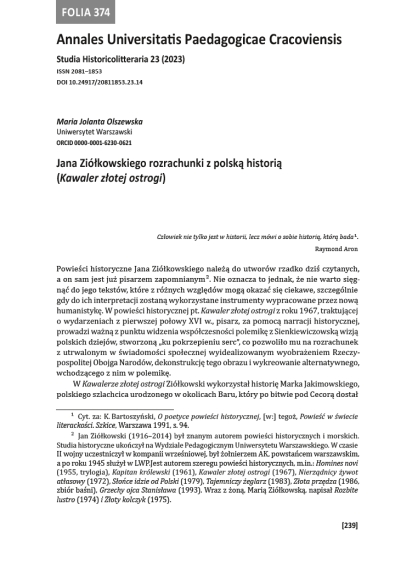
Jana Ziółkowskiego rozrachunki z polską historią ("Kawaler złotej ostrogi")
Thumbnail
View/Open
Jana Ziółkowskiego rozrachunki... (1.842Mb)
Author:
Olszewska, Maria Jolanta
xmlui.dri2xhtml.METS-1.0.item-citation: Annales Universitatis Paedagogicae Cracoviensis. 374, Studia Historicolitteraria 23 (2023), s. [239]-255
xmlui.dri2xhtml.METS-1.0.item-iso: pl
Subject:
powieść historyczna
Rzeczpospolita
Cecora
sarmatyzm
postkolonializm
Jan Ziółkowski
historical novel
the Republic of Poland
Cecora
Sarmatism
postcolonialism
Jan Ziółkowski
Date: 2023
Metadata
Show full item record
Abstract
Jan Ziółkowski’s historical novel entitled Kawaler złotej ostrogi (1967), which was preceded by the trilogy Homo novi (1955), is about the events of the first half of the 16th century. By means of historical narration, the author conducts a debate with Sienkiewicz’s vision of the Polish history, created “to comfort the hearts”. This allows the writer to reconcile with the idealized image of the Polish‑Lithuanian Commonwealth, preserved in social mentality, deconstruct its image and create an alternative to Sienkiewicz’s narration. Difficult, painful, humiliating and embarrassing issues, such as social and national differences, submission (race differentiation, dominance, subordination, inequality, oppressiveness), as well as national vices, come to the fore in the novel. The plot is about the life of three characters: Marek Jakimowski – a Catholic nobleman, Stefan Satanowski – an Arian nobleman, and Jan Stołczyn – a liberated peasant. Each of the characters experiences oppression because of an unjust system based on the principles of “golden freedom”. Ziółkowski used a traditional model of a historical novel, creatively transformed the sources that were accessible to him, and built his own historical reconciliation narrative. This is an example of engaged writing.
URI
http://hdl.handle.net/11716/14199
Collections
  • 2023, Studia Historicolitteraria 23

DSpace software copyright © 2002-2016  DuraSpace
Contact Us | Send Feedback

Deklaracja dostępności
Theme by 
Atmire NV
Logo
Budowa Repozytorium Uniwersytetu Komisji Edukacji Narodowej w Krakowie została sfinansowana ze środków Ministerstwa Nauki i Szkolnictwa Wyższego na działalność upowszechniającą naukę.

Image


Browse

All of DSpaceCommunities & CollectionsBy Issue DateAuthorsTitlesSubjectsThis CollectionBy Issue DateAuthorsTitlesSubjects

My Account

Login

DSpace software copyright © 2002-2016  DuraSpace
Contact Us | Send Feedback

Deklaracja dostępności
Theme by 
Atmire NV
Logo
Budowa Repozytorium Uniwersytetu Komisji Edukacji Narodowej w Krakowie została sfinansowana ze środków Ministerstwa Nauki i Szkolnictwa Wyższego na działalność upowszechniającą naukę.

Image