• polski
    • English
  • English 
    • polski
    • English
  • Login
View Item 
  •   DSpace Home
  • Czasopisma Naukowe
  • Annales Academiae/Universitatis Paedagogicae Cracoviensis
  • Studia Historicolitteraria
  • 2023, Studia Historicolitteraria 23
  • View Item
  •   DSpace Home
  • Czasopisma Naukowe
  • Annales Academiae/Universitatis Paedagogicae Cracoviensis
  • Studia Historicolitteraria
  • 2023, Studia Historicolitteraria 23
  • View Item
JavaScript is disabled for your browser. Some features of this site may not work without it.

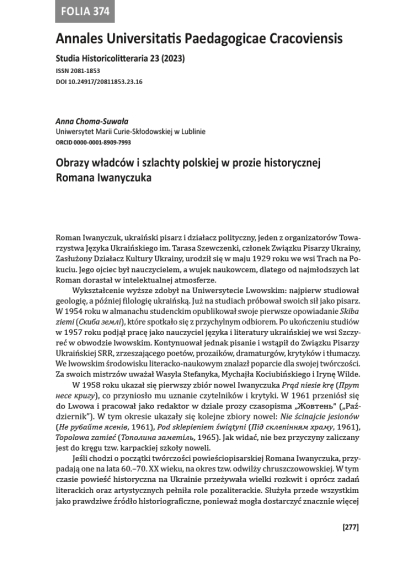
Obrazy władców i szlachty polskiej w prozie historycznej Romana Iwanyczuka
Thumbnail
View/Open
Obrazy władców i szlachty... (1.849Mb)
Author:
Choma-Suwała, Anna
xmlui.dri2xhtml.METS-1.0.item-citation: Annales Universitatis Paedagogicae Cracoviensis. 374, Studia Historicolitteraria 23 (2023), s. [277]-296
xmlui.dri2xhtml.METS-1.0.item-iso: pl
Subject:
Roman Iwanyczuk
ukraińska powieść historyczna
stereotyp
motyw
obraz
polskie postacie historyczne
Roman Iwanyczuk
Ukrainian historical novel
stereotype
motif
image
Polish historical figures
Date: 2023
Metadata
Show full item record
Abstract
The topic of the article is the image of Polish kings and nobility in Roman Iwanyczuk’s historical prose. The analysis was conducted on the basis of three works written at the turn of the 1970s and 1980s. They are only a fragment of the rich literary heritage ofthe famous Ukrainian novelist. Ciemnoczerwone wino (Черлене вино) takes the reader to the 15th century, to Galicia‑Volhynia, which was threatened with polonization. Manuskrypt z ulicy Ruskiej (Манускрипт з вулиці Руської) shows the origin of the idea of the liberation war, the future Chmielnicki Uprising, in Lviv at the turn of the 16th and 18th century. The novel Woda z kamienia (Вода з каменю) presents the beginnings of the Ukrainian national revival in Galicia and the history of the Ruthenian Trinity, with its leader Markian Szaszkewicz. The cyclicality and connections between novels, gives Iwanyczuk’s work spatiotemporal continuity, which encompasses, above all, historical events and figures. The analyzed works present a clearly negative image of the representatives of Polish society, which results from the stereotypical approach to the perception of a Pole in the 20th century Ukrainian literature. Polish rulers and nobility are portrayed through the prism of Polish‑Ukrainian relations at socio‑political, religious and ideological level.
URI
http://hdl.handle.net/11716/14201
Collections
  • 2023, Studia Historicolitteraria 23

DSpace software copyright © 2002-2016  DuraSpace
Contact Us | Send Feedback

Deklaracja dostępności
Theme by 
Atmire NV
Logo
Budowa Repozytorium Uniwersytetu Komisji Edukacji Narodowej w Krakowie została sfinansowana ze środków Ministerstwa Nauki i Szkolnictwa Wyższego na działalność upowszechniającą naukę.

Image


Browse

All of DSpaceCommunities & CollectionsBy Issue DateAuthorsTitlesSubjectsThis CollectionBy Issue DateAuthorsTitlesSubjects

My Account

Login

DSpace software copyright © 2002-2016  DuraSpace
Contact Us | Send Feedback

Deklaracja dostępności
Theme by 
Atmire NV
Logo
Budowa Repozytorium Uniwersytetu Komisji Edukacji Narodowej w Krakowie została sfinansowana ze środków Ministerstwa Nauki i Szkolnictwa Wyższego na działalność upowszechniającą naukę.

Image