• polski
    • English
  • English 
    • polski
    • English
  • Login
View Item 
  •   DSpace Home
  • Czasopisma Naukowe
  • Annales Academiae/Universitatis Paedagogicae Cracoviensis
  • Studia ad Didacticam Litterarum Polonarum et Linguae Polonae Pertinentia
  • 2015, Studia ad Didacticam Litterarum Polonarum et Linguae Polonae Pertinentia 6
  • View Item
  •   DSpace Home
  • Czasopisma Naukowe
  • Annales Academiae/Universitatis Paedagogicae Cracoviensis
  • Studia ad Didacticam Litterarum Polonarum et Linguae Polonae Pertinentia
  • 2015, Studia ad Didacticam Litterarum Polonarum et Linguae Polonae Pertinentia 6
  • View Item
JavaScript is disabled for your browser. Some features of this site may not work without it.

Piśmiennictwo polskie i oświata polska na Węgrzech
Thumbnail
View/Open
Piśmiennictwo polskie... (336.6Kb)
Author:
Várnai, Dorota
xmlui.dri2xhtml.METS-1.0.item-citation: Annales Universitatis Paedagogicae Cracoviensis. 195, Studia ad Didacticam Litterarum Polonarum et Linguae Polonae Pertinentia 6 (2015), s. [235]-241
xmlui.dri2xhtml.METS-1.0.item-iso: pl
Subject:
prayer books
school theatre
pious fathers
Polish brethren
calendars
Date: 2015
Metadata
Show full item record
Abstract
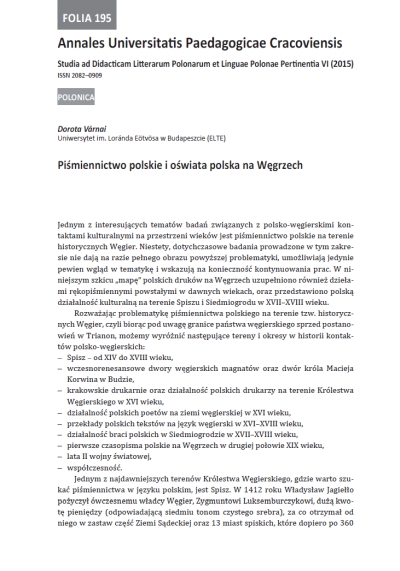
One of the most interesting research topics related to the Polish-Hungarian cultural relations in recent centuries is the question of written records created on former Hungarian territories. Unfortunately, previous research in this field does not give a full picture, it only provides insight into the topic and indicates that further research should be done. One of the oldest areas of the Kingdom of Hungary, where it is advisable to seek the written records is Spisz (Zips), where Polish prayer books were issued and Polish-language plays were written for theatre schools. The 15th and 16th century is a period of particularly common Polish-Hungarian relations. During this period scientific works were written and a lot of works has been translated from Polish into Hungarian by Poles residing in the Buda Royal Court and in the manors. In the 17th and 18th century Transylvania was another place that provided an opportunity for Polish cultural and publishing activities. The Polish brethren established Polish schools which – like in Spisz (Zips) – had to maintain Polish identity. In these schools, children and youth were taught in Polish. The next era of the Polish literacy in Hungary is the 19th century, when Polish-language periodicals appear there. This continues into the next century, during the Second World War and is still ongoing.
URI
http://hdl.handle.net/11716/14267
Collections
  • 2015, Studia ad Didacticam Litterarum Polonarum et Linguae Polonae Pertinentia 6

DSpace software copyright © 2002-2016  DuraSpace
Contact Us | Send Feedback

Deklaracja dostępności
Theme by 
Atmire NV
Logo
Budowa Repozytorium Uniwersytetu Komisji Edukacji Narodowej w Krakowie została sfinansowana ze środków Ministerstwa Nauki i Szkolnictwa Wyższego na działalność upowszechniającą naukę.

Image


Browse

All of DSpaceCommunities & CollectionsBy Issue DateAuthorsTitlesSubjectsThis CollectionBy Issue DateAuthorsTitlesSubjects

My Account

Login

DSpace software copyright © 2002-2016  DuraSpace
Contact Us | Send Feedback

Deklaracja dostępności
Theme by 
Atmire NV
Logo
Budowa Repozytorium Uniwersytetu Komisji Edukacji Narodowej w Krakowie została sfinansowana ze środków Ministerstwa Nauki i Szkolnictwa Wyższego na działalność upowszechniającą naukę.

Image