
Search
Now showing items 1-10 of 32
Hades nie zawsze funeralny – szkic o fortunności nazw podmiotów gospodarczych
(2020)
The article falls within the chrematonomastic research strand in which a proper name is understood to be a
utilitarian message with a pragmatic potential, one that ensues from both statutory requirements and marketing ...
Imiona i derywaty odimienne używane na polskiej Warmii w XIX wieku
(2020)
The article presents first names and derivatives derived from first names, used in families in Warmia in the 19th
century. The material was gathered from the work of W. Barczewski, Kiermasy in Warmia. Names in Warmian ...
Szkolnictwo protestanckie i jego wpływ na polszczyznę cieszyńską przełomu XVIII i XIX wieku
(2020)
The article presents the part of the research material based on Silesian language from the Cieszyn area. The author
analyses works written by Cieszyn protestant secondary grammar school students which have preserved in ...
Miejsce gwary opoczyńskiej w lokalnej prasie (na przykładzie kieleckich „Przemian”)
(2020)
The local press is hardly ever used for dialectological studies. Press texts from the Kielce monthly “Przemiany”;
1970–1989 can be a valuable source of language material for both the study of the language system of the ...
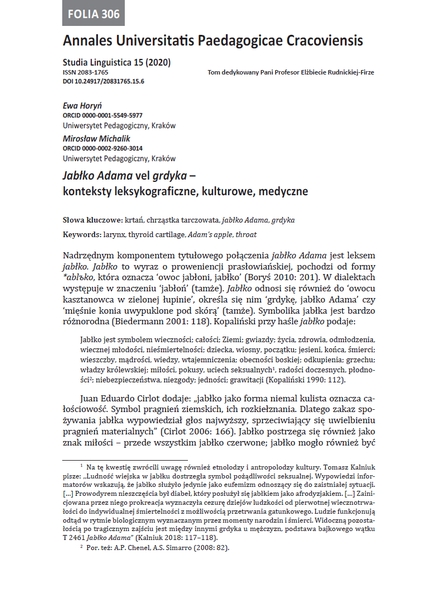
Jabłko Adama vel grdyka – konteksty leksykograficzne, kulturowe, medyczne
(2020)
Assuming the perspective of a multi-aspect overview, in this paper a linguistic-culturalterminological
analysis of thyroid cartilage (Latin cartilago thyroidea) has been made, with
special consideration given to its ...
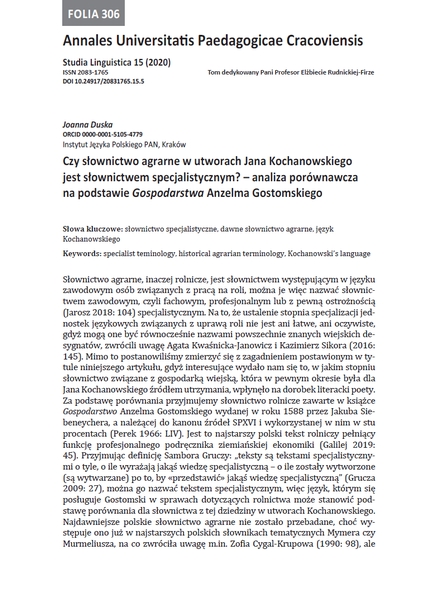
Czy słownictwo agrarne w utworach Jana Kochanowskiego jest słownictwem specjalistycznym? – analiza porównawcza na podstawie Gospodarstwa Anzelma Gostomskiego
(2020)
The aim of this article is to present agrarian terminology in Jan Kochanowski’s works and compare it with the
vocabulary used by Anzelm Gostomski, the author of the oldest Polish handbook on gentry farming. Jan Kochanowski ...
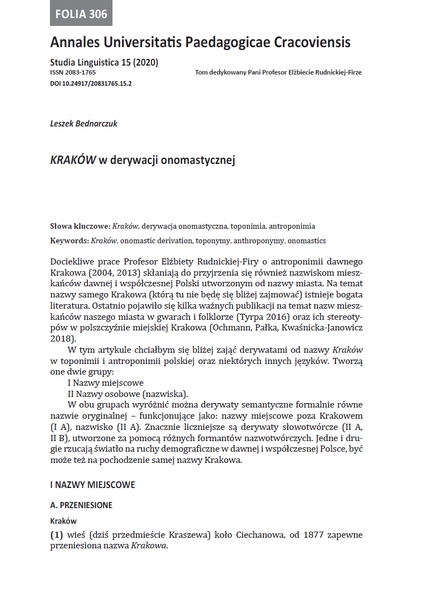
KRAKÓW w derywacji onomastycznej
(2020)
The subject of the paper are derivatives of the name Kraków in toponymy and anthroponymy of Polish and some other
languages. They form numerous, varied names (local, regional, ethnic, personal). However, they do not ...

Od prorokini do marszałkini, czyli o derywacji w miarę potrzeb
(2020)
The subject of the article is the asymmetry of gender in the Polish language, especially as far as the names of the
prestigious professions and functions are concerned (i.e. feminatives).
It also considers the function ...
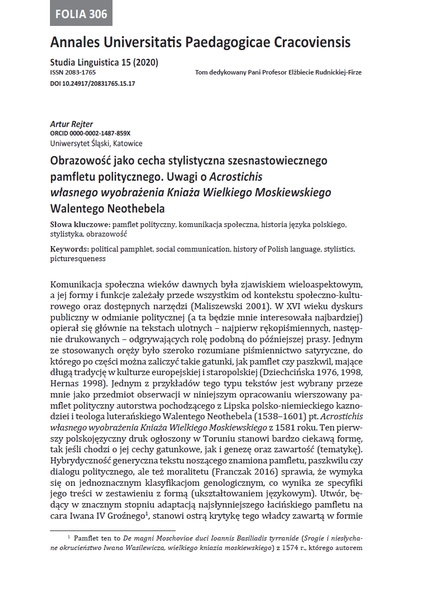
Obrazowość jako cecha stylistyczna szesnastowiecznego pamfletu politycznego. Uwagi o Acrostichis własnego wyobrażenia Kniaża Wielkiego Moskiewskiego Walentego Neothebela
(2020)
The main subject of the study is to point out the language and text exponents of picturesqueness as a style feature
of historical pamphlet of XVI th. century. The observations were made on the example of the work Acrostichis ...
Humorous and Non-Humorous Effects in Sitcoms: a Relevance-Theoretic Perspective
(2020)
Humorous utterances can be divided into those which are created for their own sake (that is, to amuse others),
dubbed autotelic humour, and those which communicate truthful and/or untruthful meanings germane to the ongoing ...