
Leontes or the desire for nothingness. Stanley Cavell’s reading of Shakespeare’s The Winter’s Tale
Abstract
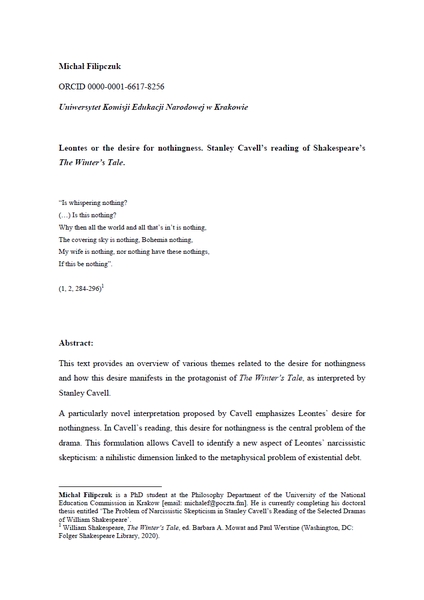
This text provides an overview of various themes related to the desire for nothingness
and how this desire manifests in the protagonist of The Winter’s Tale, as interpreted by
Stanley Cavell.
A particularly novel interpretation proposed by Cavell emphasizes Leontes’ desire for
nothingness. In Cavell’s reading, this desire for nothingness is the central problem of
the drama. This formulation allows Cavell to identify a new aspect of Leontes’
narcissistic skepticism: a nihilistic dimension linked to the metaphysical problem of
existential debt.
In this way Cavell’s formulation places Leontes alongside other Shakespearean skeptics
that he has examined in his other essays included in the Disowning Knowledge,
revealing a new epistemological dimension of Leontes’ attitude, which has often been
overlooked in traditional interpretations of The Winter’s Tale.
In the last part of the text I’m also dealing with strictly epistemological consequences of
Leontes’ nihilism for his attitude toward language. The most important aspect of this is
his rejection of shared linguistic norms and commonly accepted criteria of meaning.
This is one more aspect of is nihilism.
Collections

Except where otherwise noted, this item's license is described as Udzielam licencji. Uznanie autorstwa 4.0 Międzynarodowa (CC BY 4.0)