
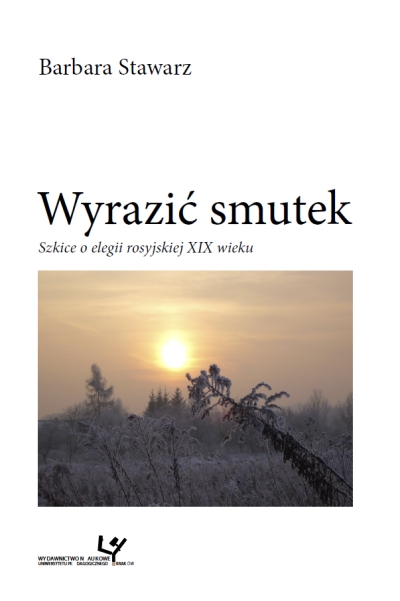
Wyrazić smutek. Szkice o elegii rosyjskiej XIX wieku
Oglądaj/
ISBN:
978-83-8084-191-8
978-83-8084-192-5 (e-ISBN)
ISSN: 0239-6025
Język: pl
Data: 2018
Metadata
Pokaż pełny rekordStreszczenie
The work is devoted to the problem of the way elegies exist in Russian poetry
of the 19th century in the works of the most outstanding poets of the genre in
the context of their aesthetic and philosophical views.
The first chapter deals with the traditions of the genre in theoretical reflection
and literary practice from Greek antiquity (e.g. Plato, Aristotle, Tibullus,
Ovid) to the Renaissance (e.g. Scaliger, Robortello) and Baroque in Western
European literature (e.g. J. Donne).
The second chapter is devoted to the statements of Russian theorists
of the 18th and 19th centuries on the topic of elegy in relation to the theory
of this genre since ancient times.
The second chapter is devoted to the statements of Russian theorists
of the 18th and 19th centuries on the topic of elegy in relation to the theory
of this genre since ancient times.
The section entitled The irreversibility of time Idyll and Elegy treats the
issue of the mutual relationships of idylls and elegies, genres which, apparently
opposing, represent the confrontation of the ideal with reality, the desire of
a man to remain in harmony with himself and with the world.
Chapter IV – The sweetness of melancholy – constitutes an attempt to present
the aesthetic views of N. Karamzin, in which a significant role is played by
the writer’s reflections on the state of melancholy, an ambivalent expression of
the emotional opposition – calming and passion.
In the chapter Sorrow – terror and pleasure the focus is on the issue of expressing
feelings, emotions and moods in the Russian language, which became
the cause of conflict, at the same time a link between the opposing associations
(Shishkovians, Karamzinists and their supporters) operating in Russia at the
turn of the 19th century.
In Chapter Six (Sadness felt in another), the issue of the elegy in K. Batuszkov’s
poetry is discussed, who considered that what was most important in an
author’s work was the process of conveying oneself to an imaginary situation
in which the artist’s imagination played the role of an important instrument.
In Chapter Seven, Sorrow – proof of the existence of beauty the elegy of
W. Zhukovsky is analysed in the context of the writer’s reflections on the category
of beauty. The essence of the understanding of the variant of elegy proposed
by the poet is his work Of melancholy in life and poetry, in which he tries
to distinguish between concepts such as sadness and melancholy, as a basis
for differentiation of the worldview criterion.
The elegy of repetition is the part of the work that presents the way elegy
functions in the work of A. Pushkin. He opens a new perspective for the genre,
returning to its ambiguous categorical mood, oscillating between the poles
of sorrow and joy, and suggesting a specific content-composition dominant,
referring to the figure of repetition – the sign of acceptance by the poet of the
possible senses of repetition in its manifold axiological and epistemological
functions.
The chapter And sadness and boredom is devoted to the elegiac poetry of
M. Lermontov, in which all the most important themes of his heritage with its
characteristic paradoxes are to be found, which allows us to weave images and
issues such as: the experience of unity and detachment with one’s own body,
the temporality and infinity of existence, oblivion and reminder, alienation
and intimacy with the Other, the desire for destruction and the desire for life.
The concept of unynye (the chapter “Unylaja” elegia – “unynye” in elegy)
appears in Russian poetry along with the need of creators to present psychological
processes in literature, independent existence starting at the moment of
crystallization typical only of Russian lyric poetry variant of elegy called unylaja.
The part entitled Elegy – elegiac – the elegiac attitude discusses the problem
of the coherence of the ideological and atmospheric integrity of the elegiac
works, which the creators obtain using the principle of cyclically combining
compositions with one dominant motif, reinforcing its eloquence by this strategy.
At the end it is pointed out that a certain mood would be a characteristic
feature of elegy and a guarantee of its duration in time as indispensable for
memory of the genre, always present, occurring in variable configurations.